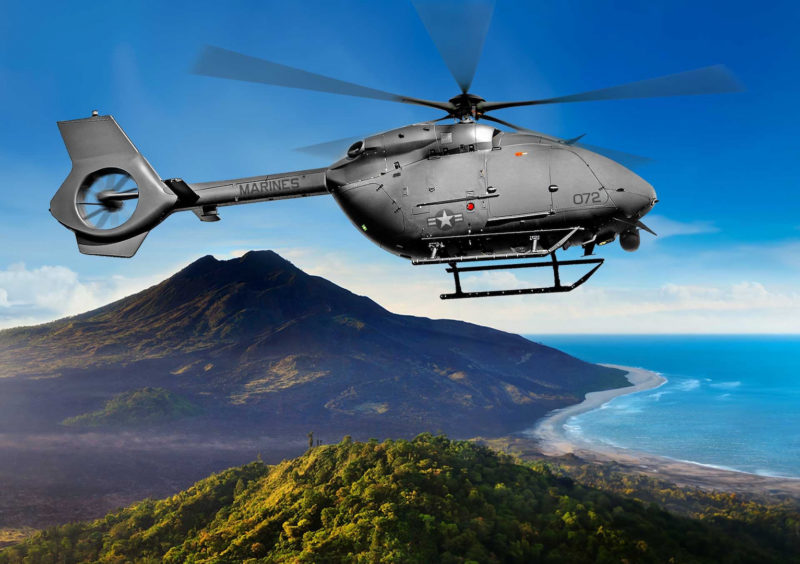
Airbus recently conducted a demonstration flight of its MQ-72C unmanned helicopter for the U.S. Army, funded entirely by the company. Originally developed for the U.S. Marine Corps’ “Aerial Logistics Connector” (ALC) program, the platform is now being pitched to the Army to capture the emerging market for unmanned logistics resupply—a capability essential for future long-range air assault operations.
Jaysen Yochim, Senior Director for the ALC program at Airbus, stated at this year’s Association of the U.S. Army (AUSA) annual meeting that the demonstration took place near Huntsville, Alabama—a key hub for Army aviation and missile research and development.
The MQ-72C completed five sorties, which included complex hovering maneuvers—simulating operations within an airfield environment—as well as standard takeoff and landing patterns. The tests also evaluated the aircraft’s ability to autonomously reroute when encountering a “no-fly zone” mid-flight; throughout the entire process, the onboard safety pilot never had to take manual control.
The MQ-72C is based on the UH-72B “Lakota” helicopter, which is itself a derivative of the Airbus H145 twin-engine light helicopter. The U.S. Army already operates the Lakota, though currently only for non-combat missions such as counter-narcotics operations and border patrol.
Airbus developed the platform in collaboration with L3Harris, Shield AI, and Parry Labs. The demonstrator is equipped with forward- and rear-facing LiDAR sensors and a nose-mounted electro-optical camera, with real-time data processing and decision-making handled by Shield AI’s “Hivemind” autonomous flight software.
Yochim noted that, as of this summer, the MQ-72C has been operated via a ground control station developed by Parry Labs, utilizing Starlink for command and control. This provides a beyond-line-of-sight (BLOS) operational capability, with the aircraft having been successfully controlled from a distance of up to 70 miles (approximately 113 kilometers). However, the nose-mounted clamshell doors—a key feature of the final configuration—have not yet been installed. This design would allow for a continuous, unobstructed main cargo bay, facilitating faster loading and unloading; however, due in part to funding delays within the Marine Corps’ ALC (Autonomous Logistics Cargo) program, integration is not expected until 2029–2030.
The Marine Corps views the ALC as a critical logistics asset for “island-hopping” operations in the Pacific. In the event of a high-intensity conflict with China, traditional logistics lines would inevitably become primary targets. The Marine Corps aims to demonstrate this capability in a near-combat environment as early as next year.
In addition to the Airbus-led team, a proposal from Near Earth Autonomy and Honeywell—based on the Leonardo AW139—has also been awarded a contract. Ultimately, only one solution is expected to be selected for procurement.
Airbus is also leveraging this opportunity to engage the U.S. Army. According to Zokin, the demonstration is intended to show the Army how far a “sister service” has advanced the program using existing funding. As the Army prepares to field the MV-75A tiltrotor aircraft, its air assault range will extend significantly; consequently, forces arriving at contested objectives will require sustained resupply.
Major General David Gardner, Commanding General of the 101st Airborne Division, noted in an interview that the division has frequently conducted air assaults from Fort Campbell to the Joint Readiness Training Center (JRTC)—a distance of approximately 500 miles (about 800 kilometers). Current helicopters must stop for refueling and resupply during such missions, and a fleet flying 500 miles at 250 knots (approximately 460 km/h) cannot simultaneously carry underslung Humvees. In the future, such operations may need to rely on autonomous logistics transport systems. However, the MQ-72C is not the only option. Last year, Sikorsky—a subsidiary of Lockheed Martin—revealed that it is developing an unmanned version of the Black Hawk, which also features a clamshell-style nose door. Meanwhile, Bell and Near Earth Autonomy are working on an unmanned cargo variant of the 505 Jet Ranger X.
While the U.S. Army does not appear to have issued a formal requirement for unmanned cargo helicopters yet, it has shown enough interest to entertain demonstrations from Airbus. As the operational reach of air assault missions extends to hundreds of miles, the ability to deliver supplies to the front lines in a timely manner will be a critical factor in the successful implementation of these new operational concepts.